Standing in my backyard last Tuesday, coffee mug in hand, I found myself staring up at the crisscrossing white streaks painting the morning sky like some cosmic tic-tac-toe game. My neighbor Bob wandered over, pointing at the trails with the confidence of someone who’d clearly watched too many YouTube videos. “Government chemicals,” he declared with a knowing nod. “They’re trying to control our minds.”
I nearly choked on my coffee. Here we were, two supposedly rational adults in the 21st century, and one of us genuinely believed the contrails streaming behind commercial airliners were part of some elaborate mind-control scheme. This moment crystallized something I’d been noticing for years: the innocent white lines trailing behind aircraft have become ground zero for one of the most persistent conspiracy theories of our time.
The truth, thankfully, is far more fascinating than fiction—and involves some genuinely remarkable atmospheric science that would make any meteorologist’s heart skip a beat.
The Science Behind the Spectacle
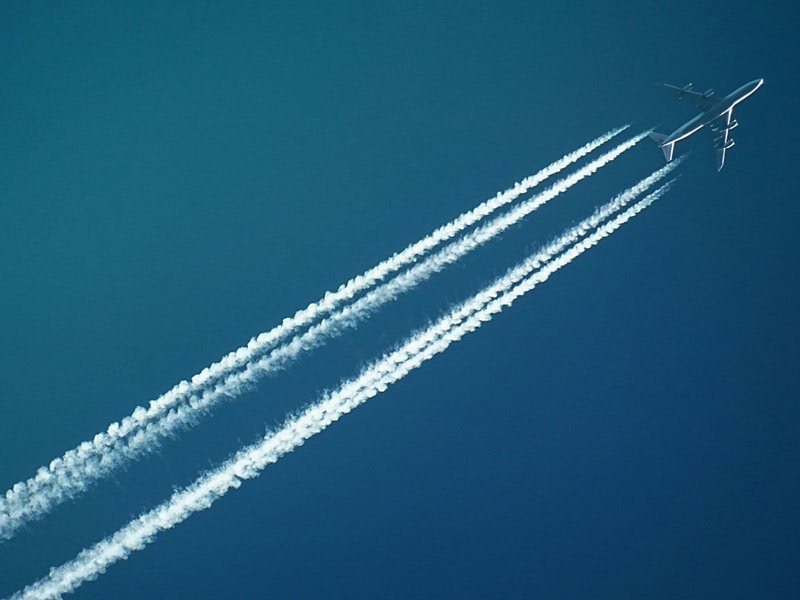
Those white lines Bob was convinced were poisoning his petunias are actually water vapor—nothing more sinister than the visible breath you see on a cold morning, just happening at 35,000 feet. When I spoke with Dr. Sarah Chen, an atmospheric physicist at Columbia University, she explained the process with the enthusiasm of someone who never gets tired of debunking pseudoscience.
“Jet engines burn fuel and produce carbon dioxide and water vapor as byproducts,” Chen told me during our phone interview. “When that hot, humid exhaust meets the extremely cold air at cruising altitude—we’re talking temperatures around -40 to -70 degrees Fahrenheit—the water vapor instantly condenses and freezes into ice crystals.”
The technical term is condensation trail, mercifully shortened to “contrail” by pilots and aviation enthusiasts who presumably got tired of saying four syllables every time they looked up. Think of it as nature’s own magic trick: invisible water vapor suddenly becoming visible clouds, performed at altitudes where the air is thinner than a politician’s promise.
But here’s where things get interesting. Not every airplane produces these trails, and the same aircraft might leave dramatic streaks one day and disappear without a trace the next. The difference lies entirely in atmospheric conditions—specifically, humidity and temperature at flight altitude.
When Physics Meets Poetry in the Sky
Dr. Chen walked me through the three types of contrails pilots and meteorologists observe. Short-lived contrails dissipate within seconds or minutes, appearing briefly behind the aircraft before vanishing like skywriting in a strong wind. These form when the upper atmosphere is relatively dry, unable to sustain the ice crystals once they move away from the engine exhaust.
Persistent contrails are the attention-grabbers—those long, straight lines that can linger for hours, slowly spreading and evolving until they resemble natural cirrus clouds. These form when the upper atmosphere is already saturated or nearly saturated with water vapor. The aircraft exhaust provides just enough additional moisture and particulates to trigger widespread ice crystal formation.
Then there are persistent spreading contrails, which sound like something from a weather forecaster’s fever dream but represent some of the most beautiful cloud formations you’ll see. Under perfect conditions—high humidity and specific temperature ranges—these trails can expand into bands several miles wide, creating what appears to be an entirely new cloud layer.
The altitude factor plays a crucial role too. Commercial aircraft typically cruise between 30,000 and 40,000 feet, where temperatures hover around -40 degrees Fahrenheit and atmospheric pressure is roughly one-quarter that at sea level. These conditions create what atmospheric scientists call the “contrail formation zone”—nature’s sweet spot for turning invisible exhaust into visible spectacle.
The Conspiracy That Won’t Die
Despite overwhelming scientific evidence, chemtrail conspiracy theories persist with the tenacity of a telemarketer during dinner. Believers claim governments are deliberately spraying chemicals to control weather, manipulate populations, or achieve various other nefarious goals. The theory has spawned countless online forums, documentaries, and the occasional awkward neighborhood conversation.
What strikes me most about chemtrail believers isn’t their skepticism—healthy skepticism is valuable—but their selective application of it. They’ll question atmospheric science while unquestioningly accepting grainy YouTube videos narrated by someone whose scientific credentials include “doing my own research” and “asking questions.”
The irony is palpable. Commercial aviation represents one of humanity’s most regulated industries, where every component is tracked, tested, and certified to exhaustive standards. The idea that airlines are secretly spraying mysterious chemicals requires believing that thousands of pilots, mechanics, air traffic controllers, and regulatory officials are all complicit in a global conspiracy. Having met airline pilots, I can confidently say most struggle to keep their flight schedules straight, let alone coordinate worldwide mind control operations.
Weather Modification: Fact vs. Fiction
Here’s where conspiracy theorists occasionally stumble onto actual science, though they typically misinterpret it spectacularly. Cloud seeding—the practice of introducing particles into clouds to encourage precipitation—is real and has been used since the 1940s. However, it bears no resemblance to chemtrail mythology.
Real cloud seeding involves specialized aircraft flying directly into existing clouds, dispersing silver iodide or other nucleating agents to enhance natural precipitation processes. The operations are conducted by government agencies or private companies under strict permits, with detailed public records and scientific monitoring. It’s about as secretive as a high school marching band.
Military weather modification research also exists, though it’s largely theoretical and experimental. The notion that commercial airliners are unknowingly (or knowingly) participating in weather control schemes requires a level of coordination that would make the Manhattan Project look like a casual book club.
The Environmental Reality
While contrails aren’t sinister government plots, they do have legitimate environmental implications that deserve serious attention. Aviation emissions contribute to climate change through carbon dioxide release, but contrails add another layer of complexity to the equation.

Persistent contrails can evolve into cirrus clouds, which have a net warming effect on Earth’s climate system. These high-altitude clouds trap outgoing longwave radiation while allowing incoming solar radiation to pass through relatively unimpeded. Recent studies suggest that contrail-induced cloudiness might contribute as much to aviation’s climate impact as direct carbon dioxide emissions.
The radiative forcing effects of contrails vary significantly based on time of day, season, and geographic location. Nighttime contrails are particularly problematic because they provide warming without the cooling effect of reflecting sunlight. This has led to interesting research into flight routing and scheduling strategies that could minimize contrail formation in sensitive atmospheric regions.
Some airlines and air traffic management systems are experimenting with contrail avoidance strategies, adjusting flight paths and altitudes to minimize persistent trail formation. It’s a balancing act between fuel efficiency, flight time, and environmental impact that represents the kind of real environmental stewardship that conspiracy theories tend to obscure.
The Beauty of Understanding

Perhaps the most tragic aspect of chemtrail conspiracy theories is how they rob people of wonder at genuine atmospheric beauty. When you understand that those spreading white lines represent ice crystals catching sunlight at impossible altitudes, when you realize you’re watching water vapor transform through phase changes governed by fundamental physics, the sky becomes infinitely more fascinating than any fictional government plot.
During my conversation with Dr. Chen, she mentioned something that stuck with me: “Every contrail tells a story about atmospheric conditions at that moment. Temperature, humidity, wind patterns, pressure systems—it’s all written there in ice crystals for anyone who knows how to read it.”
The next morning, I found myself back in the yard with my coffee, but this time armed with actual knowledge instead of Bob’s YouTube-fueled speculation. The contrails overhead weren’t government mind control—they were atmospheric science in action, visible proof that we live on a planet where water cycles between phases, where human technology intersects with natural systems in ways both beautiful and complex.
Those white lines streaking across the sky tell the story of modern aviation, atmospheric physics, and our planet’s remarkable ability to turn the mundane exhaust of jet engines into ephemeral art galleries stretched across the heavens. Understanding the real science doesn’t diminish the wonder—it amplifies it beyond anything conspiracy theories could offer.
Bob still believes they’re trying to control his mind, but at least now I have better ammunition for our next backyard conversation.

Get it Now!
Going on Vacation Soon?
Subscribe to Download our 7-Point Vacation Checklist (PDF) for FREE!
This checklist saves you valuable time by preparing for any vacation, taking care of vacation finances, securing your home while traveling, dealing with work and family matters, and getting ready to embrace your trip. Subscribe and get instant access now!
By subscribing you agree to our terms and privacy policy
- 181shares
- Share on Facebook
- Share on Twitter
- Share
- Pin