Somewhere over the Atlantic, three years ago, I made the kind of mistake that seems harmless until it isn’t. I posted a photo of my boarding pass on Instagram, giddy about a solo trip to Lisbon, barcode and all.
Two weeks later, a very confused airline representative called to ask why I’d apparently changed my seat assignment from a middle-aged software developer named Kevin. I hadn’t. Someone had scanned that barcode, pulled my frequent flyer number, and gone joyriding through my account. Kevin, wherever you are, I hope your trip was lovely.
That small humiliation taught me something every seasoned traveler eventually learns the hard way: identity theft doesn’t require a criminal mastermind. It requires a distracted tourist, a public charging port, and about ninety seconds. Airports and hotels are basically buffets for scammers, and most of us are walking around with a sign that reads “help yourself.”
Here are seven habits worth breaking before your next trip, delivered with the tough love of someone who has already made most of these mistakes herself.
Broadcasting Your Itinerary Like a Press Release

Nothing says “please rob my house” quite like a public post announcing you’ll be in Bali for two weeks starting Tuesday. Vacation excitement makes oversharing feel natural, but every geotagged photo and countdown story is a small data point for someone building a profile of you.
Scammers don’t need to hack anything sophisticated when your travel dates, home address hints, and daily location are sitting in plain sight on a public profile.
Save the highlight reel for after you’re home, or at least lock your account down to friends only. Future you, sipping a piña colada blissfully unaware, will thank present you for not turning the trip into a real-time burglary schedule.
Treating Public Wi-Fi Like It’s Trustworthy
Airport Wi-Fi named “Free_Airport_WiFi_Connect” is about as trustworthy as a stranger offering candy from an unmarked van, yet millions of travelers connect without a second thought.
Unsecured networks let anyone with basic tools intercept whatever you’re sending, including banking logins, email passwords, and that group chat where you’re complaining about the middle seat.
Fake hotspots mimicking legitimate airport or café networks are alarmingly common, designed specifically to harvest personal data from anyone who connects. A cheap VPN solves most of this problem instantly, encrypting your traffic so that even if a criminal is lurking on the same network, they’re staring at gibberish instead of your Chase login.
Skipping this step to save five dollars a month is the financial equivalent of leaving your front door unlocked because the deadbolt felt like too much effort.
Turning Your Passport Into a Prop for the ‘Gram
Few things scream “amateur hour” quite like a passport photo splashed across social media, held up proudly like a trophy at security. Full name, birth date, passport number, and often a signature, all captured in high resolution and uploaded for the world to zoom into.
Identity thieves don’t need to steal your physical passport when you’ve cheerfully photographed every relevant detail and handed it to the internet for free.
Boarding passes deserve the same suspicion. Barcodes embedded in them can reveal frequent flyer numbers, booking references, and enough information to let someone poke around inside your travel accounts, as Kevin from Lisbon can attest. Save the “bon voyage” post for a shot of your shoes on the tarmac instead. Nobody needs to see your document number to know you’re excited about Portugal.
Letting the Nightstand Drawer Double as a Vault
Hotel rooms are lovely, but they are not Fort Knox, and treating the nightstand drawer like a secure storage facility is a rookie move. Housekeeping staff, maintenance workers, and anyone with a keycard have access to that room throughout your stay.
Leaving passports, extra credit cards, or printed itineraries scattered around invites exactly the kind of casual theft that’s nearly impossible to trace back to a single culprit.
Most hotels provide an in-room safe for a reason, and using it takes roughly thirty seconds. For properties without one, a portable travel lock or even keeping essentials on your person solves the problem. Physical documents left in plain sight are just as vulnerable as digital ones, a fact that seems obvious in hindsight and somehow escapes most of us mid-vacation.
Reusing the Same Password for Every Single App
Confession time: for years, my banking password and my airline rewards password were embarrassingly similar, differing only by a single exclamation point I felt very clever about. This is, according to every cybersecurity expert alive, an astonishingly bad idea.
When one account gets breached, and hotel booking sites and airline apps get breached with numbing regularity, criminals immediately try that same password everywhere else.

A password manager removes the burden of memorization entirely, generating unique combinations for every login without requiring you to remember a single one. Adding two-factor authentication to banking and email apps provides a second layer that stops most opportunistic thieves cold, even if they somehow get hold of a password. Vacation is meant to be the one time your brain gets a break, so let software carry this particular weight instead of your memory.
Trusting Random Charging Kiosks With Your Life Force
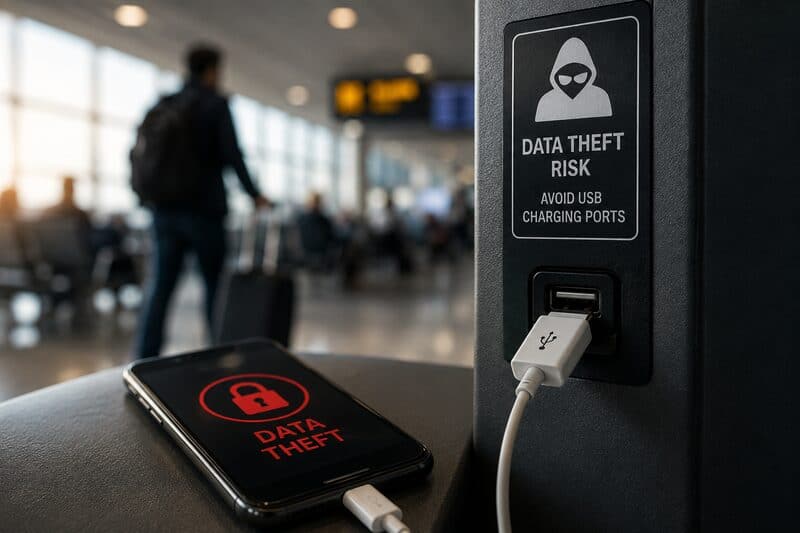
Phone batteries die at the worst possible moments, usually right as boarding begins, and those public charging kiosks scattered through airport terminals look like salvation.
Unfortunately, some of them have been compromised to install malware or extract data through the USB connection itself, a technique charmingly nicknamed “juice jacking” by security researchers who clearly enjoy a good pun as much as I do.
Carrying a portable charger eliminates the temptation entirely and costs less than a single airport sandwich. For situations where a public outlet is genuinely the only option, a simple USB data blocker allows power to flow while blocking any data transfer, which is a small piece of plastic doing an outsized amount of protective work. Your phone’s battery life is not worth gambling your financial information for.
Tossing Boarding Passes in the Nearest Trash Can
Landing feels like permission to stop being vigilant, and that relaxed mindset is exactly when travelers get sloppy. Boarding passes, luggage tags, and hotel receipts get crumpled into airport trash bins without a second thought, each one containing booking references, partial account numbers, or names and addresses that dumpster-diving scammers have been known to collect deliberately.
Shredding these documents at home, or simply tearing barcodes into confetti before disposal, takes seconds and closes off an entire category of theft that’s disturbingly analog in an otherwise digital crime. It’s the paper equivalent of leaving a spare key under the doormat, except the doormat is a public trash can and the key opens your frequent flyer account.
A Final Boarding Call

Travel is supposed to loosen us up, and that’s precisely why it’s such fertile ground for identity theft. Vigilance feels like an odd companion for a beach vacation, but a few small habits, a locked social account, a portable charger, a shredded boarding pass, cost almost nothing and prevent a genuinely miserable homecoming spent on hold with a bank’s fraud department.
Kevin never did explain how he ended up in my seating chart, and I never found out either. Some mysteries are best left at 30,000 feet. Pack accordingly, protect the paperwork, and enjoy the trip.

Get it Now!
Going on Vacation Soon?
Subscribe to Download our 7-Point Vacation Checklist (PDF) for FREE!
This checklist saves you valuable time by preparing for any vacation, taking care of vacation finances, securing your home while traveling, dealing with work and family matters, and getting ready to embrace your trip. Subscribe and get instant access now!
By subscribing you agree to our terms and privacy policy
- 128shares
- Share on Facebook
- Share on Twitter
- Share
- Pin