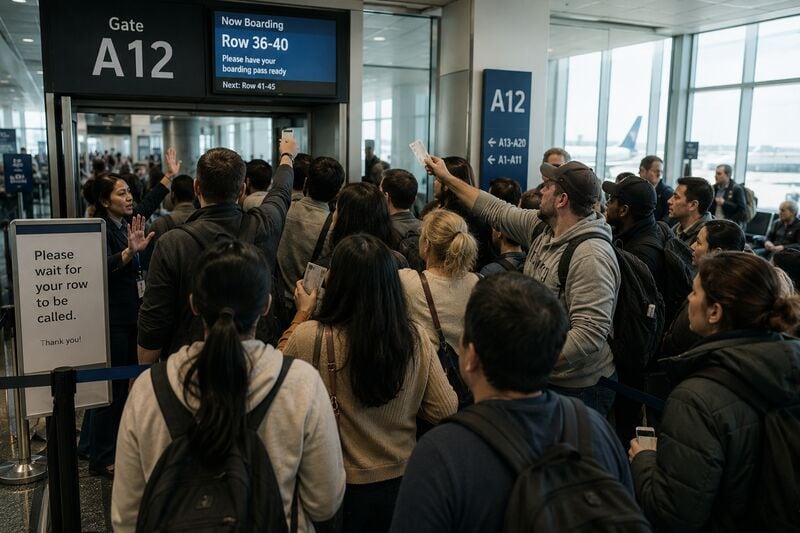
My flight to Denver was still forty minutes from boarding when I noticed the swarm. Twelve or fifteen passengers had abandoned perfectly good seats near gate A12 to stand shoulder to shoulder in front of a closed door, watching a gate agent who hadn’t so much as touched her microphone.
Nobody was reading. Nobody was on a laptop. Everybody was simply standing, facing forward, the way cattle face a barn they know will open eventually. I asked the woman beside me which boarding group she was in. “Four,” she admitted, without moving an inch. She had a solid twenty minutes to go, and still she guarded her patch of terminal carpet like it was the last umbrella stroller left at a Costco sample table.
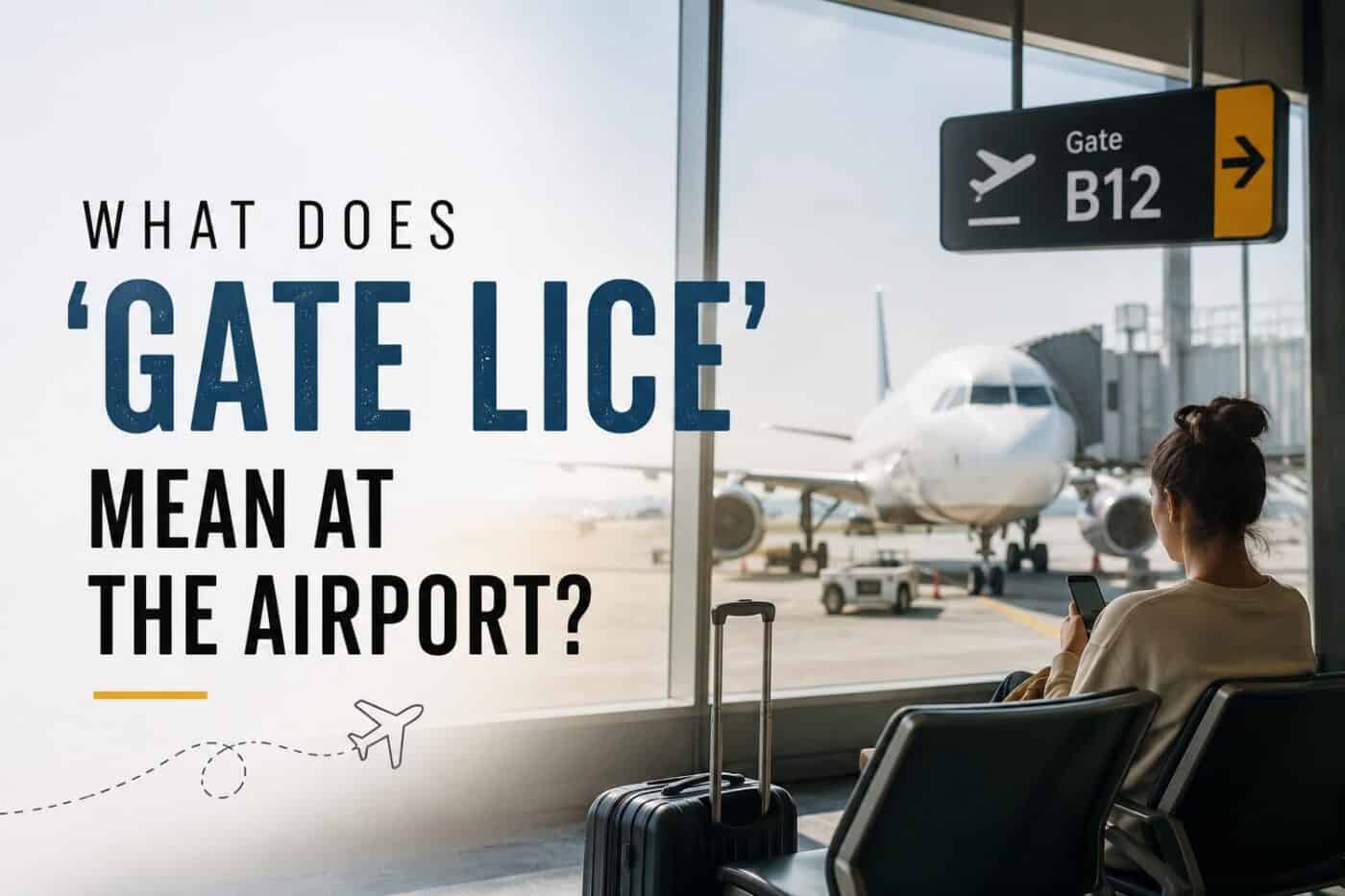
Airline workers have a word for what she was doing, and for what I, admittedly, do more often than I’d like to confess. They call it gate lice, and once someone tells you the term, you will never watch a boarding gate the same way again.
A Pest With a Paper Trail
Gate lice isn’t new slang cooked up on social media last month. Frequent flier forums like FlyerTalk have used the phrase for well over a decade, and Gary Leff, who runs the aviation site View From the Wing, has traced its popularity back to roughly 2010, not long after airlines began charging fees to check a bag.
That timing is no accident. Once checking a suitcase started costing money, the pressure to carry everything onto the plane, and to protect a spot for it in the overhead bin, went up considerably. Leff said that gate lice tend to cluster most heavily on leisure routes at peak travel times, pointing to Sunday flights out of Orlando as a prime specimen habitat.
The Official Definition, More or Less
Cambridge Dictionary made things official in January 2025, adding gate lice to its list of new words and defining the term as an informal way of describing people who crowd around the boarding gate and try to board before their row or section is called.
Wikipedia’s entry is blunter still, calling it a pejorative term for passengers who gather in front of the gate well before their designated boarding time.
Kolin Jones, a certified pilot who runs the private aviation company Amalfi Jets, put it simply when asked to define the term for people outside the industry: gate lice, in his description, are travelers who stand up early, crowd the gate area, and take up space long before boarding actually starts.
Why Nice People Behave Badly at Boarding Gate
Nobody wakes up planning to become a gate louse. Bin space anxiety does most of the recruiting. Overhead compartments fill up fast on a packed flight, and once they’re full, gate agents start tagging carry-ons to be checked, free of charge but not free of dread if you packed anything fragile or irreplaceable inside. Boarding early, even by two or three zones, feels like a form of insurance.
Confusion plays a supporting role too. Gate announcements get garbled over aging intercoms more often than any airline would like to admit, and travelers who can’t quite hear their zone tend to inch closer just to be safe. Add a cluster of elite-status fliers who genuinely do have priority boarding, standing near the door because the rules say they can, and everyone else starts mirroring their posture without noticing it. Psychologists might call this social proof. Frequent fliers just call it Tuesday.
Then there’s the broader emotional weather system of air travel itself, sometimes nicknamed “hurry up and wait.” You race to the airport, race through security, race to the gate, and then stand there with nowhere left to race toward. Loitering near the door, even uselessly, gives anxious travelers something that feels like forward motion.
A Field Guide to the Species
Not all gate lice infest the terminal for the same reason, and spending enough time in airports will teach you to spot the subspecies.
There is the Overpacker, whose personal item has visibly exceeded the dimensions of a personal item, edging closer to the door as if proximity alone might shrink a duffel bag stuffed with two weeks of vacation clothing.
There is the Status Flexer, who holds no actual priority but has decided that standing near travelers who do counts as a kind of borrowed privilege. Families with strollers, car seats, and a toddler already sprinting toward the jet bridge form their own honest and mostly forgivable colony, since nobody begrudges a parent trying to get ahead of a meltdown.
And then there is the Just-in-Case Loiterer, drifting toward the gate for no reason beyond a vague sense that stillness equals falling behind. Spend a layover watching any one of these types operate and boarding starts to feel less like air travel logistics and more like a nature documentary, narrator voice optional but strongly encouraged.
Airlines Start Swatting Back
Airlines have decided gate lice are a genuine operational problem, not merely an aesthetic one. American Airlines began testing new boarding software in the fall of 2024 at Albuquerque, Tucson, and Reagan National airports, then expanded it to more than a hundred U.S. airports ahead of the holiday travel season that followed.
Here’s how it works: if a passenger scans a boarding pass before their assigned group is called, the system emits an audible tone, flags the gate agent’s screen, and rejects the scan outright, sending the hopeful early boarder back toward their seat, publicly and audibly. Passengers traveling with a companion in an earlier group can still be waved through manually, so families aren’t accidentally split apart at the jet bridge.
American isn’t alone in rethinking how people funnel onto planes. Southwest Airlines, long famous for open seating that essentially rewarded aggressive gate-hovering, announced a switch to assigned seating beginning with 2026 flights, quietly removing much of the incentive to camp out early in the first place.
United Airlines had already reshuffled its own boarding order back in 2023, moving economy window-seat passengers ahead of their aisle and middle-seat neighbors to cut down on the shuffle-and-squeeze choreography at row 34.

Reactions to the beeping-scanner approach split roughly down the middle. Rule followers tend to find it satisfying, the aviation equivalent of a referee finally blowing the whistle. Repeat offenders find it mortifying, since a public tone announcing your premature scan is not exactly a subtle correction.
Either way, gate agents seem grateful for backup, since policing a boarding zone used to depend entirely on memorizing faces and hoping nobody argued too loudly.
The Concourse as Comedy Club
Enforcement stories travel fast on Reddit, and travelers seem to enjoy them more than almost anything else in the boarding process. One passenger described a gate agent at the Pensacola airport who firmly turned back anyone attempting to board out of turn, prompting a commenter to compare the moment to a parent threatening to turn the car around, minus the part where the parent never actually does it.
Another thread described a gate agent who vowed to confiscate and gate-check the bag of anyone caught sneaking into an earlier zone, a policy commenters cheered on with the enthusiasm usually reserved for a buzzer-beater. Somewhere between outrage and relief, watching gate lice get shooed back to their seats has become its own small spectator sport, complete with color commentary.
How to Avoid Becoming One Yourself

Escaping the infestation mostly comes down to trusting the system you already paid into. Boarding groups exist precisely so nobody needs to guess, and staying seated until yours is called rarely costs more than a minute or two of actual boarding time.
Checking the gate screen or app instead of the crowd solves most confusion problems on its own, no hovering required. If overhead bin space genuinely worries you, a bag sized to fit under the seat sidesteps the entire competition, and boarding near the back of the plane, counterintuitively, often means less bin space has been claimed by the time you arrive.
And if a carry-on does end up tagged at the door, it usually reappears at baggage claim with no charge and no real drama, whatever your nervous system might be insisting in the moment.
None of this makes the pull toward the gate disappear entirely. I caught myself standing near the door in Denver that day too, technically in Group 3, technically allowed to be there, but early enough to know exactly what I looked like.
Gate lice, it turns out, aren’t really a separate species from the rest of us. They’re just travelers who let a very human impulse win out over a printed boarding pass, one anxious inch of terminal carpet at a time.

Get it Now!
Going on Vacation Soon?
Subscribe to Download our 7-Point Vacation Checklist (PDF) for FREE!
This checklist saves you valuable time by preparing for any vacation, taking care of vacation finances, securing your home while traveling, dealing with work and family matters, and getting ready to embrace your trip. Subscribe and get instant access now!
By subscribing you agree to our terms and privacy policy
- 117shares
- Share on Facebook
- Share on Twitter
- Share
- Pin