The filthy truth about the one habit you think is keeping you clean at 35,000 feet.
My last flight to London, I watched a man emerge from the airplane lavatory with dripping hands, smugly wiping them on his jeans as though he’d just performed a public health service.
I wanted to hand him a pamphlet. Instead, I just moved my snack cup further from the aisle.
Here’s what most travelers don’t know: washing your hands on a plane may actually be doing you more harm than good.
The Sink Is Not Your Friend Up Here

Walk into any airplane lavatory and the first thing that hits you is the smell, which is its own form of biological warfare. But what you can’t smell is arguably worse. Studies on aircraft surface contamination have found that the lavatory faucet handle ranks among the most bacteria-laden surfaces on any commercial flight, often worse than the toilet flush button itself.
Think about that for a moment. The thing you grab to start “cleaning” yourself is, microbiologically speaking, a handshake with every passenger who visited before you.
The faucet knobs and handles in airplane bathrooms are touched by hundreds of hands per flight, rarely sanitized between use, and positioned in a space so small you have to do a kind of sideways shimmy just to face the mirror. Every touch transfers. Every splash redistributes. The sink basin itself has tested positive for coliform bacteria, a charming category that includes organisms originating from the human gut.
The Water Situation Is Worse Than You Think
Here’s where things get genuinely unsettling. The aircraft water supply used in lavatory sinks is not the same as the bottled water the flight attendant hands you with a smile. It comes from onboard water tanks that are filled at various airports around the world, sometimes in regions with different sanitation infrastructure, and these tanks are not always cleaned with the frequency you’d hope.
A 2019 study published in a travel health journal tested water from commercial aircraft and found measurable levels of bacterial contamination in a significant portion of samples. The EPA’s Aircraft Drinking Water Rule, introduced in the United States, was literally created because this was a documented, recurring problem, not a hypothetical one.
Rinsing your hands under water that itself carries bacterial load is, at best, a lateral move. You are not cleaning your hands. You are moistening them with ambiguous liquid and then touching the faucet handle again to turn it off.
Wet Hands Are a Bacteria Highway
Even if the water were pristine, there’s a deeper issue that most people skip past in their rush to feel virtuous: wet hands transfer bacteria at dramatically higher rates than dry hands.
Research in microbiology has consistently shown that hand-to-surface transmission increases by orders of magnitude when hands are damp. The moisture creates a physical medium that bacteria travel through more efficiently. So when you wash your hands, don’t dry them properly (because the paper towel dispenser is either empty, jammed, or producing a single square the size of a Post-it note), and then grab the door handle on the way out, you have essentially given every microbe a water slide.
On the ground, this is manageable. In the cramped ecosystem of a plane bathroom, with a door handle that every other passenger will also touch, you have become an inadvertent spreader. Your intentions were noble. The microbiology does not care.
The Hand Dryer Is Not Here to Help You
Some newer aircraft have replaced paper towels with electric hand dryers, which sounds like progress until you learn what research has shown about them. Multiple peer-reviewed studies, including a notable one from the University of Cambridge, found that jet air dryers can spread bacteria from hands into the surrounding air and onto nearby surfaces. In a room the size of an airplane lavatory, “nearby surfaces” means everything.
You dry your hands. The dryer aerosolizes whatever was on them. You breathe it in. The person after you breathes it in. This is not a horror film. This is Tuesday on a transatlantic flight.
What You Should Actually Do Instead
None of this means you should abandon hand hygiene entirely at altitude. Quite the opposite. The solution is simply smarter than a sink.
Alcohol-based hand sanitizer with at least 60% ethanol is your best ally on a flight. It requires no water, no faucet handles, no paper towel roulette, and no confined mist of recycled air bacteria. Apply it after using the lavatory, before eating, and after touching surfaces like tray tables (which famously test worse than most bathroom surfaces anyway, because they are cleaned even less often).

Keep a small bottle in your seat pocket or personal bag. This is not paranoia; it’s the same logic that hospitals have applied for decades. Healthcare settings moved toward hand sanitizer not because handwashing is bad, but because in high-traffic, high-contamination environments, sanitizer is more reliably effective when done correctly, which almost no one does.
The CDC and WHO both acknowledge that when soap and clean water are not available, or not reliably clean, hand sanitizer is the preferred alternative. An airplane lavatory qualifies on both counts.
A Note on the Psychology of Washing
There’s something worth acknowledging here: we wash our hands on planes partly because it feels like the responsible thing to do. The ritual is reassuring. Water running over your palms signals cleanliness in a primal, satisfying way that a squirt of gel simply doesn’t replicate.
On my flight back from Tokyo once, I stood at that tiny sink for a full 20 seconds of conscientious scrubbing, nodded at myself in the mirror, and then grabbed the door handle with my freshly washed hand on the way out. I felt very clean for approximately four seconds.
Behavioral hygiene research calls this “moral licensing,” where performing one virtuous act gives us psychological permission to be less careful afterward. The act of washing, however ineffective the conditions, makes us feel done. Protected. Finished with the hygiene portion of the flight.
Hand sanitizer, ironically, may actually keep us more vigilant because it doesn’t carry the same ritual finality. You use it, it dries fast, and you haven’t convinced your brain that the job is fully complete.
The Bottom Line at Cruising Altitude

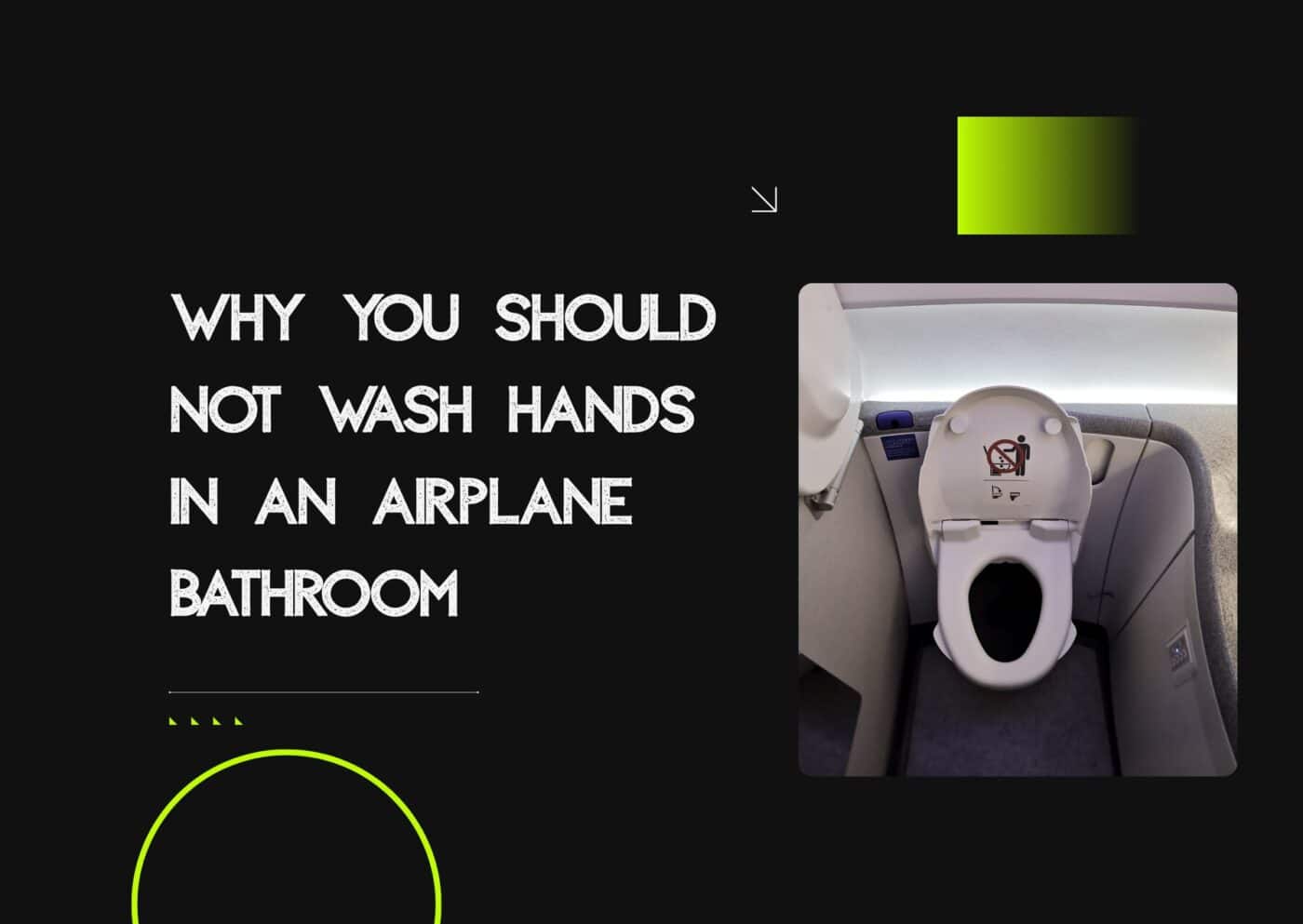
Airplane bathrooms are marvels of engineering and nightmares of microbiology. The space, the surfaces, the water, the airflow, and the sheer volume of human traffic conspire to make a well-meaning handwash somewhere between useless and counterproductive.
Skip the sink. Carry the sanitizer. And maybe stop touching the tray table altogether, but that’s an article for another flight.
- 78shares
- Share on Facebook
- Share on Twitter
- Share
- Pin