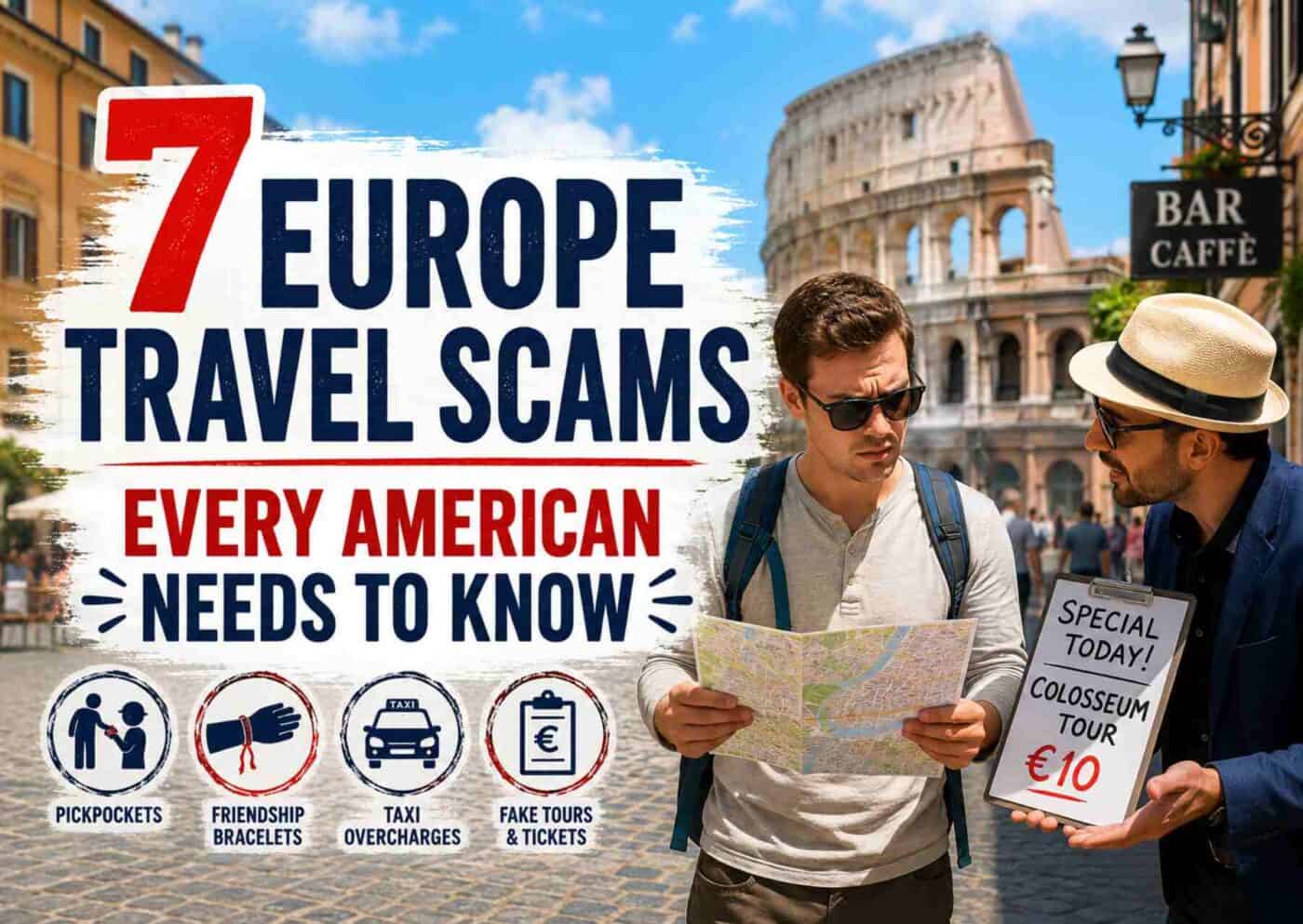
I’ve crossed the Atlantic more times than I can count on two hands, and every single trip has taught me something new about the gap between how Americans travel and how Europe actually works.
My first real education came in Rome, circa 2014, when a cheerful man in a centurion costume thrust his feathered arm around my shoulder, grinned for the photo I hadn’t asked to take, and then demanded 20 euros with the dead-eyed conviction of a toll booth operator. I paid it. I didn’t want to. I just didn’t know I could say no.
That moment turned me into the unofficial travel scam correspondent for every friend and family member who mentions a European trip. Before you book anything, here’s what I tell them.
1. The “Friendship Bracelet” Ambush
 Friendship bracelets seller in Paris
Wander near the steps of Sacré-Cœur in Paris or along any major tourist promenade and you’ll encounter them: men holding colorful strings, smiling warmly, reaching for your wrist. They call it a gift. It is not a gift.
What actually happens is this: a friendship bracelet gets tied around your wrist with practiced speed before you’ve even processed what’s going on. Once it’s on, they demand payment, sometimes aggressively, while their associates crowd around you. Refusing feels socially impossible in the moment, which is entirely by design.
My advice: keep your hands in your pockets and walk with purpose. A polite but firm “non, merci” delivered without breaking stride is your best weapon. Eye contact optional. Guilt, absolutely forbidden.
2. The Taxi Without a Meter
Landing at an unfamiliar European airport after a red-eye flight, bleary-eyed and desperate for a shower, is precisely when unlicensed taxi drivers make their move. They stand just outside the arrivals hall holding signs, looking official, and quoting flat rates that sound reasonable until you realize the metered fare would have been half the price.
Unofficial taxis outside of airports in cities like Athens, Lisbon, and Naples are a well-documented problem. Always pre-book through your hotel, use a licensed taxi rank identified by official signage, or use a ride-share app where the price is fixed before you get in. If a driver approaches you first, that’s your first red flag. Licensed drivers don’t need to hunt.
3. The Distraction Pickpocket Crew
This one operates like a well-rehearsed theater troupe, and I mean that with genuine admiration for its choreography. One person bumps into you, spills something on you, shoves a clipboard of signatures in your face, or drops something at your feet. While your attention is on that, their partner relieves you of your phone, wallet, or passport.
Pickpocketing crews are most active on crowded metro lines (looking at you, Barcelona’s L3), at major tourist sites, and near ATMs. What makes them effective is that they exploit the basic human instinct to respond to social disruption. You look at the distraction. You’re supposed to.
Carry your crossbody bag in front of you in crowds. Keep your phone in a front pocket. A money belt sounds unglamorous, and it is, but so is spending your vacation canceling credit cards from a police station. Choose your aesthetic battles accordingly.
4. The ATM “Helper”
Let’s say you’re standing at a European ATM trying to figure out why your card keeps getting rejected. A friendly local appears beside you, offering assistance. They’re helpful, warm, and watching your PIN with the focused attention of a hawk spotting a field mouse.
ATM skimming and shoulder surfing are separate but equally unpleasant scams. Skimming involves a card reader device attached over the real card slot; shoulder surfing involves a human being memorizing your PIN so that when they later steal your card, or a copy of it, they can clean out your account.
Shield your PIN entry with your other hand every single time, no exceptions. Look for any unusual attachments on the card slot before inserting your card. Use ATMs attached to actual bank buildings rather than standalone machines on busy tourist streets. And if anyone offers to “help” you at an ATM, that offer is the scam.
5. The Restaurant Menu Switcheroo
Sitting down at a charming café on a cobblestone side street in Florence sounds like exactly what a European vacation should be. But if a tout outside the restaurant personally invited you in, or if you weren’t given a menu immediately, start paying attention.
Some restaurants in high-tourist areas operate a classic bait and switch: the menu shown outside (or verbally quoted) lists reasonable prices, while the actual bill includes items you didn’t order, mysterious “cover charges,” inflated prices that don’t match what you saw, and a general attitude suggesting you should simply pay and be grateful for the experience.
Before ordering anywhere, ask for a printed menu with prices. Check for a posted price list near the entrance, which is legally required in many European countries. If the waiter rattles off prices verbally without a menu in hand, that’s a performance, not a service.
6. The Fake “Police Officer” Shakedown
This one shook me when I first heard about it from a fellow traveler in Prague, because it exploits the instinct to cooperate with authority figures. Two men approach you, often in plain clothes or convincing-looking uniforms, claim to be plainclothes police officers, and ask to inspect your wallet for “counterfeit currency.” Your wallet never comes back quite right.

Variations include demanding to see your passport and then “fining” you for a made-up infraction, or insisting your currency is illegal and must be confiscated for “inspection.”
Real police officers in Europe do not randomly approach tourists to inspect their wallets. If someone claiming to be a cop stops you, do not hand over your wallet or passport. Instead, tell them you’ll accompany them to the nearest official police station. Real officers won’t object. Fake ones will vanish.
7. The “Free” Roses and Rosemary
Romantic settings seem to attract romantic-adjacent scams, which perhaps says something about the cynicism required to operate a tourist trap. In Paris especially, women approach couples holding a single red rose and offer it as a gift. Once the girlfriend is holding it and the boyfriend is smiling, it suddenly costs 10 euros and the pressure to pay in front of your partner is its own form of hostage-taking.
A variation popular in Provence and along the French Riviera involves women pressing sprigs of rosemary into your hand while murmuring something that sounds like a blessing. It is not a blessing. It is an invoice.
Refuse the object before it reaches your hand. Once you’re holding it, psychologically you’ve already accepted it, which is the entire mechanism of the scam. A raised palm and a polite “no thank you” works beautifully, and you’ll feel genuinely powerful doing it.
A Final Note Before You Go

None of this is meant to frighten you out of booking that trip. Europe is extraordinary, the people are largely wonderful, and the vast majority of your interactions will be with bakers, bartenders, and museum guards who couldn’t care less about your wallet. But informed travelers are harder targets, and harder targets have better vacations.
Print this list. Text it to your mother before she goes to Barcelona. Know the plays before someone runs them on you. And if a man in a Roman centurion costume gets within arm’s reach, run.

Get it Now!
Going on Vacation Soon?
Subscribe to Download our 7-Point Vacation Checklist (PDF) for FREE!
This checklist saves you valuable time by preparing for any vacation, taking care of vacation finances, securing your home while traveling, dealing with work and family matters, and getting ready to embrace your trip. Subscribe and get instant access now!
By subscribing you agree to our terms and privacy policy
- 291shares
- Share on Facebook
- Share on Twitter
- Share
- Pin