My first ride on the New York City subway happened twenty minutes after I landed at JFK, soaked in sweat, dragging a suitcase that weighed more than my self-respect, and fully convinced that the flashing arrows on the platform were some kind of cruel municipal prank.
Within minutes, a stranger grabbed my suitcase, hauled it up three flights of stairs without saying a word, and vanished into the crowd before I could even say thank you. That, I would learn, is the subway in a nutshell: chaotic, occasionally rude, frequently delayed, and somehow capable of producing moments of pure New York grace when you least expect them.
Visitors tend to arrive armed with myths about the system, equal parts horror story and urban legend, and most of those myths evaporate the moment they actually ride it. Riding the subway well requires a handful of practical skills, a tolerance for unpredictability, and a sense of humor sturdy enough to survive a delayed F train.
Consider this dispatch a field guide, written by someone who has spent enough hours underground to consider the 4/5/6 platform at Union Square a kind of second living room.
Getting Your Fare Sorted: OMNY, MetroCards, and the Tap-and-Go Era
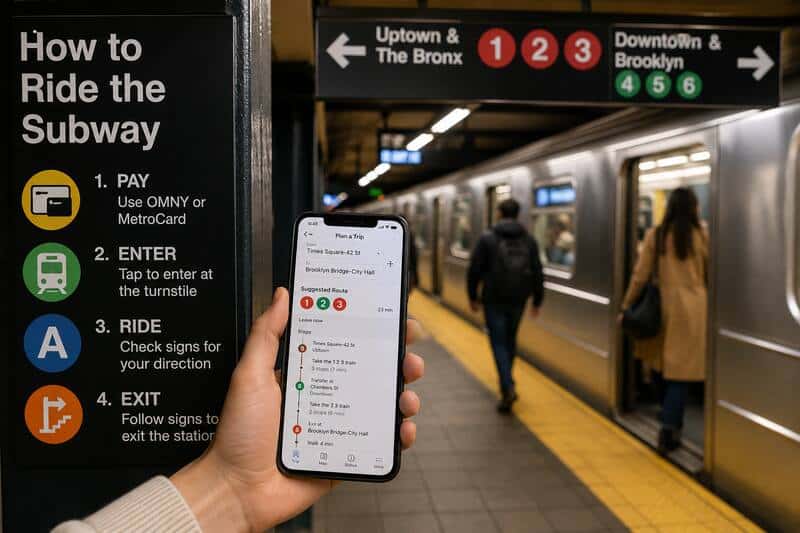
Tapping a credit card or phone against the turnstile reader gets riders into the system faster than fumbling with a paper card ever did. OMNY, the contactless payment system the MTA rolled out, lets visitors skip the ticket machine entirely and just tap a debit card, credit card, or smartphone wallet at the turnstile. Fares cap automatically too: ride enough times in a single week and the system simply stops charging, a small mercy buried inside an otherwise unforgiving fee structure.
Paper MetroCards still exist for now, sold at vending machines in most stations, though their days appear numbered as OMNY keeps expanding. Buying one isn’t complicated, but the machines can be fussy about crumpled bills, so a clean five-dollar bill or a working card saves considerable frustration.
Either method works equally well, and neither requires advance planning beyond making sure a payment method is charged and ready.
Reading the Map Without Losing Your Mind
Color-coded lines look intimidating on a phone screen until the logic clicks into place. Letters and numbers identify each line (the 4, the L, the Q), while colors group lines that share track for stretches of their route, which explains why three differently labeled trains might show up on a single platform.
Express trains skip stations that local trains stop at, a distinction that trips up newcomers constantly and occasionally strands them in Brooklyn when they meant to get off in Manhattan.
Station names rarely match neighborhood names, which adds another layer of confusion for anyone navigating by guesswork alone. Apps like Citymapper and Google Maps handle the routing math far better than any human brain managing jet lag, so downloading one before departure beats trying to decode a paper map mid-platform.
Uptown and downtown matter more than left or right, since trains run along avenues rather than compass directions, and confusing the two sends plenty of visitors several miles in the wrong direction before anyone notices.
Unwritten Rules Every Rider Learns the Hard Way
Pole position near the door belongs to whoever boards first, and reclaiming it requires the kind of quiet assertiveness New Yorkers practice from childhood. Backpacks come off and get held at riders’ feet during crowded hours, a small courtesy that takes up less room and earns fewer glares. Eye contact stays minimal, conversation stays quiet, and personal space gets respected even when there technically isn’t any.
Holding doors for a stranger sprinting toward a closing train earns genuine goodwill, though doing it for someone three platforms away earns nothing but a delayed train and forty annoyed commuters. Showtime performers, the acrobats who treat subway poles as gymnastics equipment, deserve a wide berth and maybe a dollar if the trick was good.
Mariachi bands, string quartets, and the occasional wandering saxophonist turn certain platforms into pop-up concert halls, and tossing a few coins into an open instrument case counts as basic cultural participation rather than charity.
Safety, Common Sense, and a Healthy Respect for Rats
Standing behind the yellow line feels excessive until a train roars past at full speed inches from a platform edge, at which point it feels like the only sane piece of advice in this entire guide.
Empty subway cars sitting inside an otherwise crowded train almost always contain something unpleasant, whether that something is a puddle, a smell, or a passenger mid-argument on speakerphone, so a little detective work before boarding pays off.
Rats living along the tracks have achieved minor celebrity status, complete with viral videos and the occasional pizza-carrying legend, yet they pose roughly zero threat to anyone standing on the platform rather than crouching beside the rails.
Pickpockets target distracted tourists far more than rodents ever do, so keeping a wallet in a front pocket matters considerably more than worrying about wildlife. Late-night travel remains generally safe across most of Manhattan and increasingly across the boroughs, though sticking to busier stations and well-lit cars after midnight remains a smart habit rather than paranoia.
Timing It Right: Rush Hour, Weekends, and Everything In Between
Squeezing onto a 6 train at 8:45 on a Tuesday morning offers a uniquely intimate experience with several hundred strangers’ elbows, and avoiding that particular ritual ranks among the smartest moves a first-time visitor can make.
Weekday rush hour runs roughly 7 to 9:30 in the morning and 4:30 to 7 in the evening, and sightseeing during those windows means competing with commuters who have zero patience for tourists studying a map mid-doorway.
Weekend service runs on its own logic entirely, with track work rerouting lines, skipping stops, and occasionally replacing trains with shuttle buses without much warning. Checking the MTA’s website or app before a Saturday excursion saves the headache of standing on an empty platform wondering why the train that should have arrived nine minutes ago has apparently joined a different timeline.
Late nights and early mornings offer the calmest rides of all, perfect for anyone willing to trade a bit of sleep for a subway car they can actually stretch out in.

Apps, Maps, and Tools Worth Downloading
Citymapper, Google Maps, and the official MTA app all calculate routes, estimate arrival times, and flag service changes with reasonable accuracy, though none of them predicts human behavior, which remains the system’s true wildcard.
Real-time arrival boards inside most stations display countdown clocks that occasionally lie with great confidence, so treating any listed arrival time as a rough suggestion rather than a promise keeps expectations realistic.
Offline maps saved before a trip prevent the particular panic of losing signal underground precisely when a transfer decision needs to be made. Apple Pay and Google Pay both work at OMNY readers, removing one more reason to carry cash specifically for transit.
Cell service inside many stations has improved dramatically over the past several years, though tunnels between stations remain a dead zone where texts simply vanish into the void until the next platform appears.
Subway Personality: Why the Hassle Is Worth It
Underground musicians, breakdancing teenagers, candy sellers announcing their wares like carnival barkers, and the occasional costumed performer turn an average commute into something close to a moving variety show.
Delays happen constantly, announcements remain nearly unintelligible through ancient speaker systems, and somehow none of that diminishes the strange charm of watching an entire city’s worth of humanity packed into one rattling steel tube.
Travelers who approach the system with patience tend to walk away with better stories than anyone who spent the week exclusively in taxis. Subway rides offer a cross-section of New York that no observation deck or bus tour can replicate, full of contradictions, small kindnesses, and the occasional saxophone solo nobody asked for but everyone secretly enjoys.
Final Thoughts Before You Tap In

Confusion fades fast once the basic rhythms click, and most first-timers find themselves navigating like seasoned locals by their third or fourth day underground.
Mastering the subway means embracing a little chaos, tapping in with confidence, and trusting that even a wrong turn usually just leads to an interesting detour rather than a disaster.
My suitcase-hauling stranger from that first night never got a proper thank you, but every time I help a confused tourist find the right platform now, I figure the debt gets a little closer to paid.

Get it Now!
Going on Vacation Soon?
Subscribe to Download our 7-Point Vacation Checklist (PDF) for FREE!
This checklist saves you valuable time by preparing for any vacation, taking care of vacation finances, securing your home while traveling, dealing with work and family matters, and getting ready to embrace your trip. Subscribe and get instant access now!
By subscribing you agree to our terms and privacy policy
- 338shares
- Share on Facebook
- Share on Twitter
- Share
- Pin