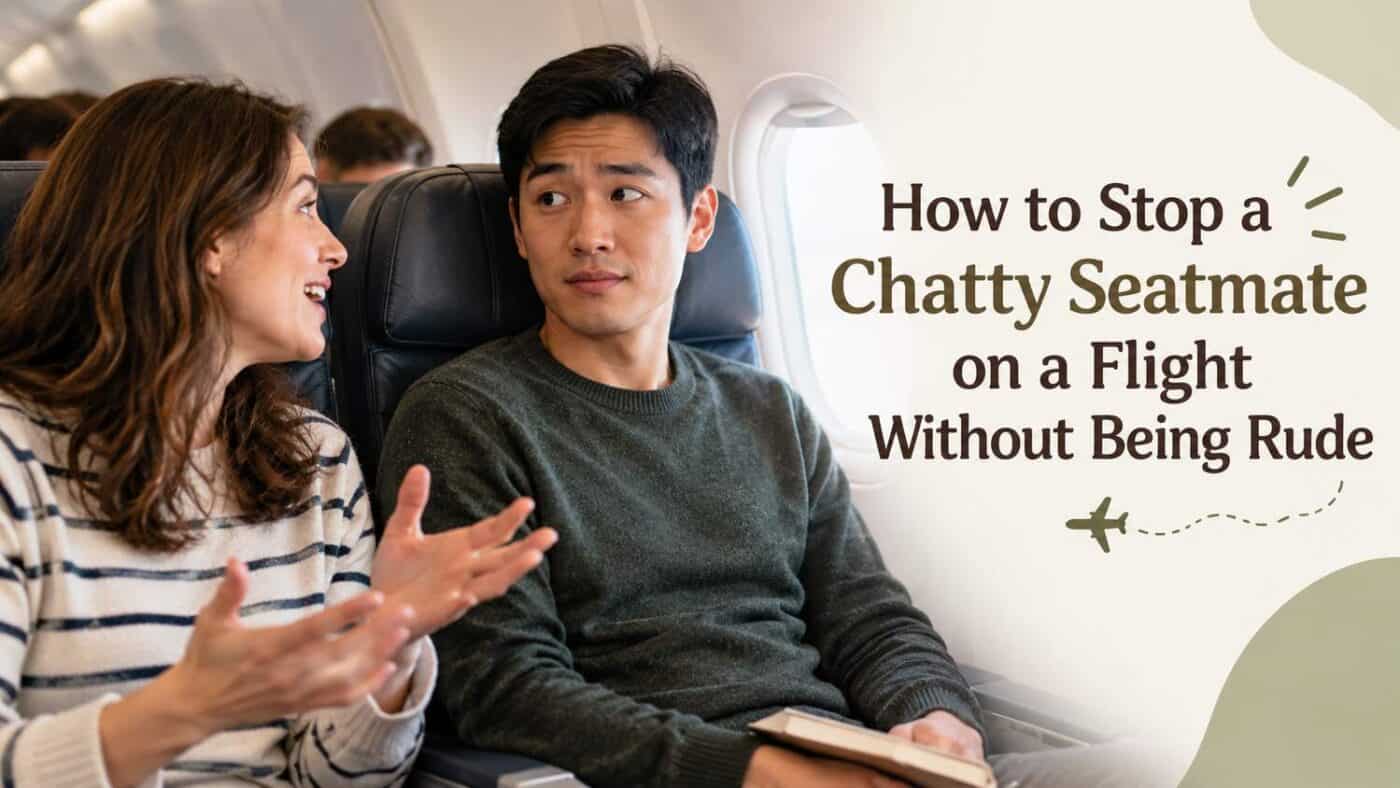
Somewhere over Nebraska, a stranger named Gary once told me his entire life story, including a graphic account of his gallbladder surgery, before the seatbelt sign had even switched off.
By cruising altitude, I knew his ex-wife’s maiden name, his firm opinions on air fryers, and exactly why he no longer speaks to his brother-in-law. Nobody asked for any of this. Somewhere around hour three, I understood that I had become an unpaid hostage negotiator, minus the megaphone and the training.
Frequent flyers all have their own Gary. Air travel has a peculiar way of turning strangers into confessional booths hurtling through the sky, and learning how to close that booth gently, without triggering an international incident in seat 14C, is a genuinely useful life skill.
Dozens of flights, one unsolicited fantasy football recap, and a great deal of trial and error have taught me there is a better way to handle it.
Understand Why Strangers Suddenly Won’t Stop Talking
Psychologists have a name for this phenomenon: the “strangers on a train” effect. Confined spaces, the promise of never seeing this person again, and a healthy dose of nervous energy about flying combine into the perfect conditions for oversharing.
Nervous flyers often talk to self-soothe. Bored ones talk because three hours without a phone signal feels like a small eternity. Lonely ones talk because a captive audience doesn’t come around often.
Altitude and confinement seem to loosen inhibitions the way a good happy hour does, minus the drinks. Surveys on flight anxiety consistently list chatting up a neighbor as one of the more common coping mechanisms, right alongside gripping the armrest and silently negotiating with turbulence.
None of this means engaging with every word is required. It simply means a little empathy helps. Approaching a chatty neighbor with the assumption that they mean well, rather than that they’re deliberately testing your patience, makes the maneuvers ahead feel less like an escape plan and more like a kindness.
Send Signals Before a Single Word Is Spoken
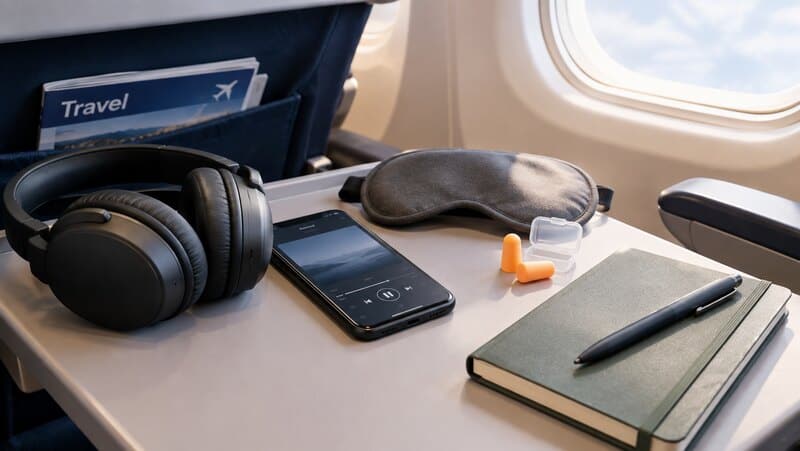
Boarding is prime real estate for setting expectations. Headphones going in on the jet bridge, before anyone has the chance to make eye contact, communicate volumes without a syllable spoken. A book already open on the tray table, a laptop already glowing, or sunglasses perched for a nap all function as social do-not-disturb signs.
Eye contact is the real culprit here. Sustained eye contact during boarding practically issues an engraved invitation to conversation. A friendly nod paired with a quick glance back at a screen keeps things warm without opening the floodgates.
Small choices in those first ninety seconds tend to shape the next several hours more than anything said afterward.
Master the Closed Loop Answer
Once conversation starts, silence isn’t the goal. Containment is. Enter the closed loop answer: short, complete, and offering nothing new to grab onto. A question about travel plans doesn’t need “I’m heading to Denver for my sister’s wedding, then we’re driving up to the mountains for a week, then…” It needs “Denver, for a wedding.” Full stop.
Open-ended follow-ups are the real enemy. “How about you?” is basically handing the microphone back. Answering, then returning to a book or screen without lingering, tells a chatty seatmate the floor has closed, politely and without a single unkind word.
Deploy Props Like a Seasoned Diplomat
Nothing ends a conversation faster, or with less collateral damage, than a well-timed prop. Headphones remain the gold standard, and noise-cancelling ones send an especially unmistakable message. A sleep mask slipped on mid-sentence, paired with a soft “I’m going to try to rest,” works nearly every time and rarely offends, since nobody wants to be the villain who kept a tired traveler awake.
Snacks work too, in a strange way. Chewing is a socially acceptable reason to pause a conversation, and a meal tray provides a built-in excuse to focus elsewhere for twenty minutes. Even a crossword puzzle held up at just the right angle can function as a small, cheerful fortress wall.
A neck pillow, snapped into place with theatrical finality, sends a similarly unmistakable signal, one that requires zero words and invites zero argument.
Use a Graceful Exit Line
Sometimes props alone won’t cut it, and a direct, friendly line does the job better. A few phrases that consistently work without a hint of rudeness:
- “I should try to knock out some work before we land.”
- “I’m going to close my eyes for a bit, long week.”
- “I promised myself I’d finish this chapter before we touch down.”
Delivered with a smile, none of these read as a rejection. They read as a traveler managing their own time, which happens to be true. Tone carries most of the weight here. A warm voice paired with a firm boundary lands very differently than a curt one ever could.

Skip the Rookie Mistakes
Overcorrecting causes just as much trouble as staying too polite for too long. Feigning sleep with a dramatic head bob and a snore that fools nobody tends to backfire, since a seatmate who suspects the ruse often tries even harder to shake the sleeping act loose.
Curtness works about as well. Answering every question with a flat “yep” or “nope” reads less like a boundary and more like an invitation for someone to fill the awkward silence with even more chatter.
Checking a watch every ninety seconds, sighing audibly, or turning bodily away mid-sentence crosses from subtle into unmistakably chilly. None of these tactics land as intended, and most simply extend the very conversation they’re meant to end. Subtlety, oddly enough, works far better than obvious avoidance ever does.
Call In the Professionals When Needed
Occasionally, a seatmate simply doesn’t take a hint, no matter how many headphones go on or masks come down. Flight attendants field this more often than passengers realize, and quietly asking about an open seat elsewhere on the plane is a completely normal request.
Framing it around comfort, extra legroom, an aisle preference, keeps things smooth and avoids putting anyone on the spot.
Crew members function, in a sense, as professional mediators of small human frictions at thirty thousand feet. Using that resource isn’t rude. It’s practical, and it’s what they’re there for.
A Final Word From Seat 14C
Gary and I landed on good terms, as it happens. He learned nothing about my gallbladder, and I learned more about fantasy football waiver wire strategy than any person strictly needs.
Somewhere between the sleep mask and a well-timed “I should rest up,” things wound down naturally, and the rest of the flight passed in comfortable, mutual silence.
Politeness and peace don’t have to be opposites on a plane. With the right signals, a few closed loop answers, and a graceful exit line delivered at just the right moment, most chatty seatmates can be redirected without a single feather ruffled, leaving everyone free to enjoy the shared, slightly absurd experience of hurtling through the sky together in a metal tube.

Get it Now!
Going on Vacation Soon?
Subscribe to Download our 7-Point Vacation Checklist (PDF) for FREE!
This checklist saves you valuable time by preparing for any vacation, taking care of vacation finances, securing your home while traveling, dealing with work and family matters, and getting ready to embrace your trip. Subscribe and get instant access now!
By subscribing you agree to our terms and privacy policy
- 268shares
- Share on Facebook
- Share on Twitter
- Share
- Pin