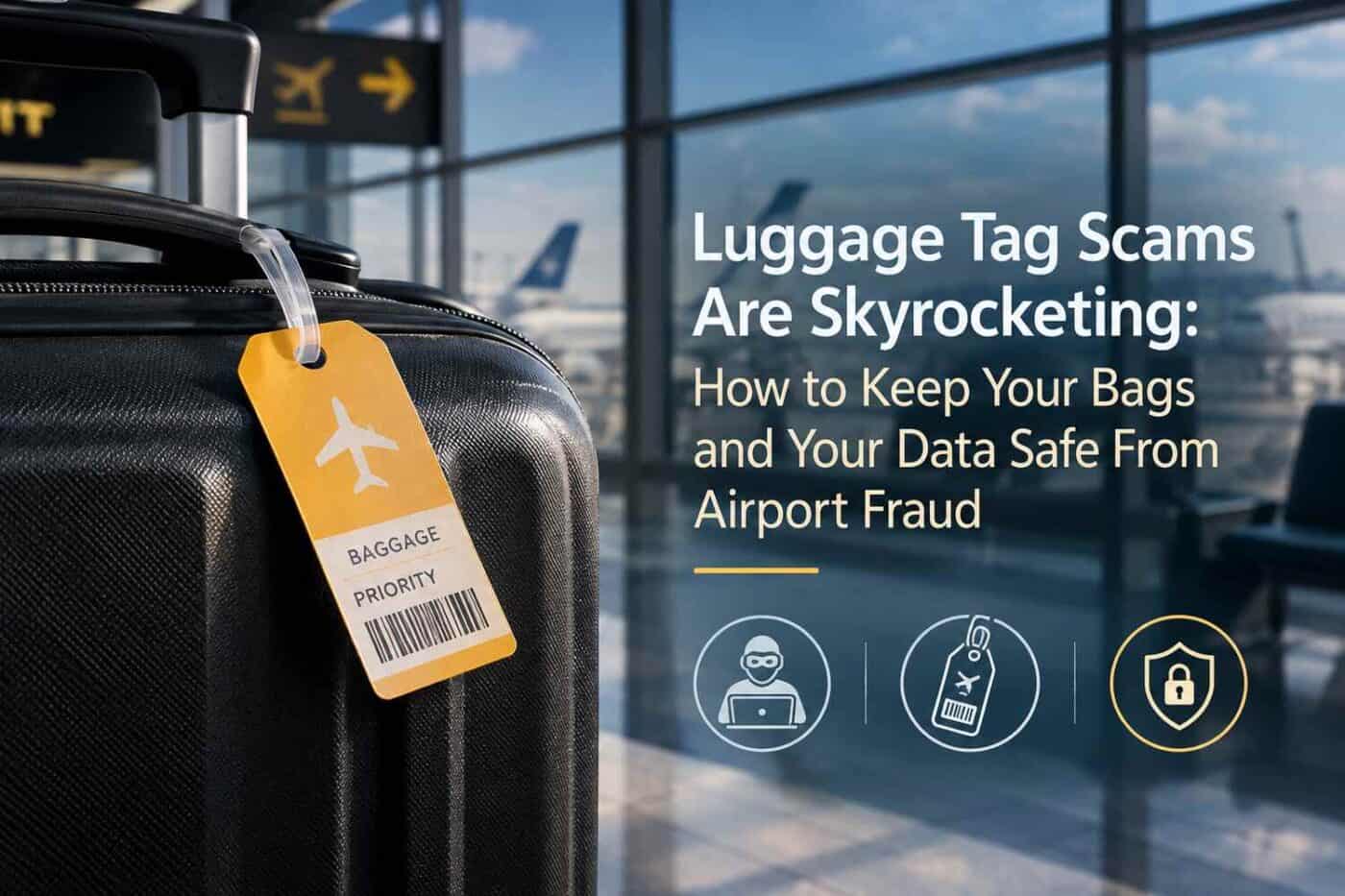
Somewhere in a Newark Airport trash can sits a little strip of paper with my name, my flight number and enough information to fund somebody’s stolen weekend in Cancun.
I ripped it off my suitcase handle the moment I spotted the carousel, tossed it without a second thought, and walked off feeling very proud of my own efficiency. Turns out that habit, shared by roughly every traveler on earth, has quietly become a criminal’s favorite side hustle.
Airlines call it mishandled baggage fraud. Everyone else is calling it the luggage tag scam, and it is spreading through baggage claim areas faster than a stroller through a jet bridge.
What Exactly Is the Luggage Tag Scam?
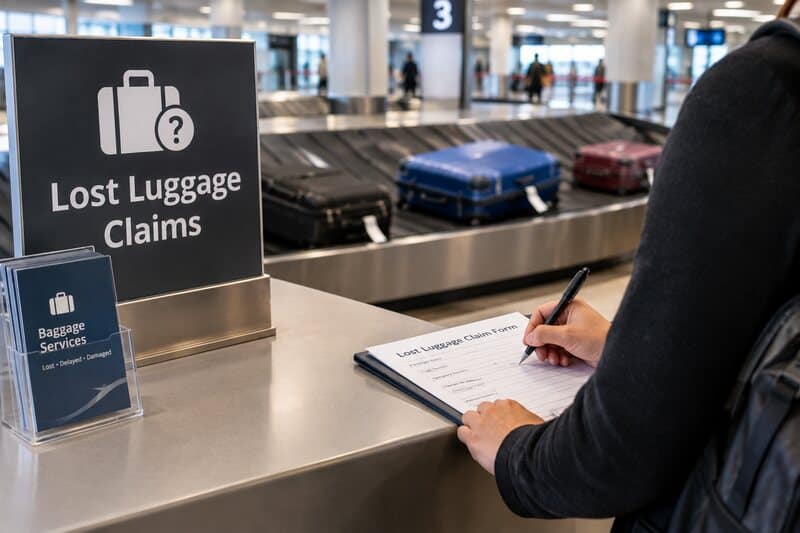
Picture the plain white strip an airline staples to your suitcase handle at check-in. It looks disposable, functions like a receipt, and gets treated with all the reverence of a gum wrapper the second bags hit the carousel. Fraudsters have figured out that this “disposable” tag is actually a small treasure map.
According to accounts that circulated widely online, criminals collect discarded tags from bins, floors and hotel trash cans, then use the details printed on them to file fake lost luggage claims under someone else’s name, even though that traveler’s suitcase arrived home just fine. Nobody has to hack anything. They just need your trash.
Why a Flimsy Paper Tag Is Worth More Than It Looks
Check your own tag next time before you rip it off. That tag typically discloses a traveler’s full name alongside the itinerary confirmation number tied to their booking. Beyond that, the printed details usually run through last name, flight number and destination code, finishing with a barcode that links straight back to the airline’s internal tracking system for that bag.
Combine those details, and a stranger has effectively been handed your travel itinerary gift-wrapped with a bow. Filing a claim that mimics your real trip becomes less hacking and more filling out a form correctly, which is exactly what makes this scam so unglamorous and so effective.
Money is the motive. Domestic baggage liability in the United States tops out at $4,700 under Department of Transportation rules for mishandled baggage in domestic air transportation. International trips fall under the Montreal Convention, which caps compensation closer to $1,700 to $2,000. Multiply either figure across dozens of fake claims, and a pile of garbage-can paper starts to look like a modest criminal enterprise.
Real Cases, Real Money
This is not internet folklore dressed up for clicks. Federal prosecutors charged two people in 2021 with conspiracy to defraud airlines, in a scheme accused of producing more than 180 missing bag claims. One London resident also pleaded guilty in 2024 to filing fake lost luggage travel insurance claims worth about £75,000, north of $100,000, before getting caught by the City of London Police.
More recently, awareness spiked after someone claiming to work baggage claims for a major airline described watching the scam happen in real time.
A Delta baggage claims manager posted on Reddit describing a rise in fraudulent claims for missing items that weren’t coming from the actual bag owners. Their post went viral for good reason: it turned an abstract warning into a firsthand account from someone standing at the scene of the crime every single shift.
How the Scam Actually Plays Out
Nobody needs a laptop or a Wi-Fi password for this one. Fraud here runs on patience and a decent set of eyes.
According to that account, scammers watch for travelers removing their tags in baggage claim areas, then retrieve them from trash bins once discarded. Hotel staff have reported similar pickings from tags left behind in guest rooms, so your suitcase isn’t even safe once you’ve checked into the hotel.
Boarding passes carry comparable risk, since they display much of the same personal information, and travel photos posted on social media can leak those same details to anyone scrolling by.
Genuine scale here stays murky. Industry observers note that while cases are increasing, the scam may not yet be extremely widespread, and no government agency or major airline has published official statistics confirming it has reached epidemic levels. Small comfort, maybe, but worth knowing before you start shredding every receipt in your wallet out of paranoia.
Can Airlines Actually Catch the Fakes?
Good news for the honest majority: airlines aren’t entirely defenseless against this. Most carriers can cross-reference a claim against baggage scan logs and RFID tagging data, which record exactly where and when a bag moved through the system.
A suitcase that scanned onto a carousel in Denver an hour before a “missing bag” report gets filed tends to raise a flag pretty quickly. That doesn’t stop every fraudulent claim from slipping through, but it does mean a stolen tag isn’t an automatic payday, and it explains why most schemes rely on volume rather than any single big score.

How to Keep Your Bags and Data Safe
Fixing this problem does not require a security clearance. It requires patience, a shredder and the willingness to look slightly odd holding onto a piece of paper for an extra hour.
- Leave the tag on until you’re home or checked into your hotel room, rather than peeling it off the second your bag appears.
- Shred it instead of binning it, especially the barcode section that ties back to your itinerary.
- Skip the airport trash can. Some airports, including several in Japan, provide secure disposal bins for tags.
- Treat your boarding pass the same way, since it carries similar identifying details and gets discarded just as carelessly.
- Think twice before posting a photo of a tagged suitcase or boarding pass online, even as a harmless travel flex.
- Consider a QR code or digital tracker as a lower risk alternative to the standard barcode strip on future trips.
None of this requires becoming the person who guards their luggage like a Wells Fargo stagecoach. Small habits, repeated automatically, do the job.
If You Think You’ve Already Been Targeted
Suspect a bag tag went walking without you? Contact the airline directly and ask whether any claims have been filed under your name or confirmation number.
Keep your own boarding pass, receipt and baggage claim ticket as proof your trip went exactly as planned, in case a fraudulent claim surfaces later and needs untangling.
A Small Piece of Paper, a Big Headache

Please be careful with that little strip of paper. It looks like garbage, but airport fraudsters treat it like a paycheck, and taking your tag off the moment you spot your suitcase means handing over enough of your travel itinerary for someone else to cash in on your trip.
Rip it off at home instead, feed it to a shredder, and let the only thing you lose at baggage claim be five minutes waiting for the carousel to start.
- 108shares
- Share on Facebook
- Share on Twitter
- Share
- Pin